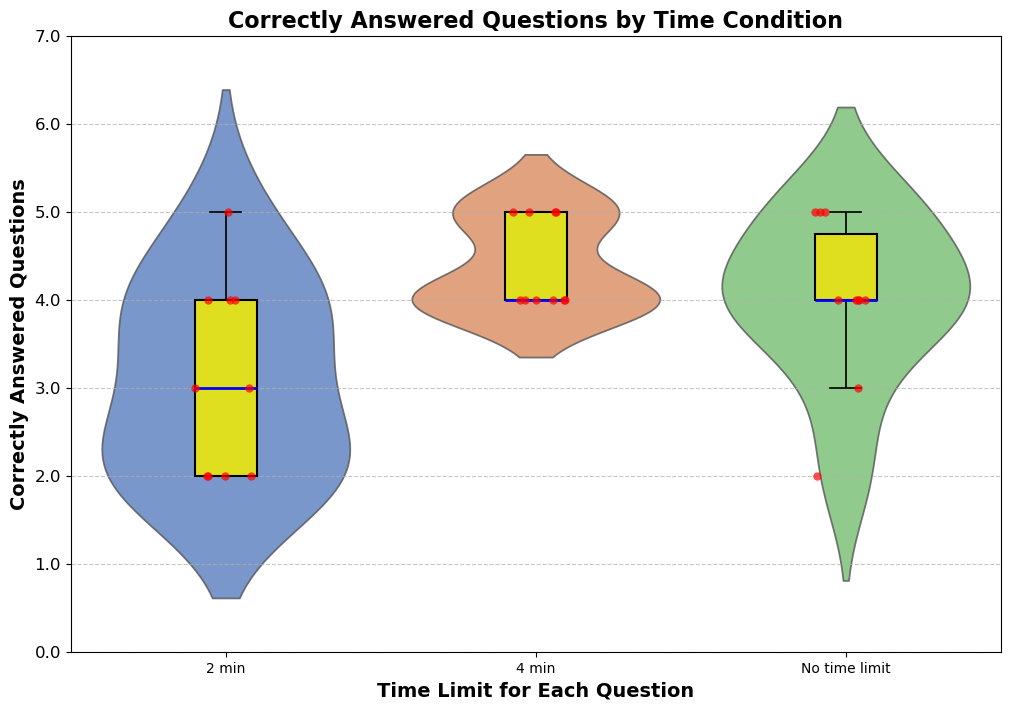
Raincloud box plot shows how many correctly answered questions the participants had across different time conditions.
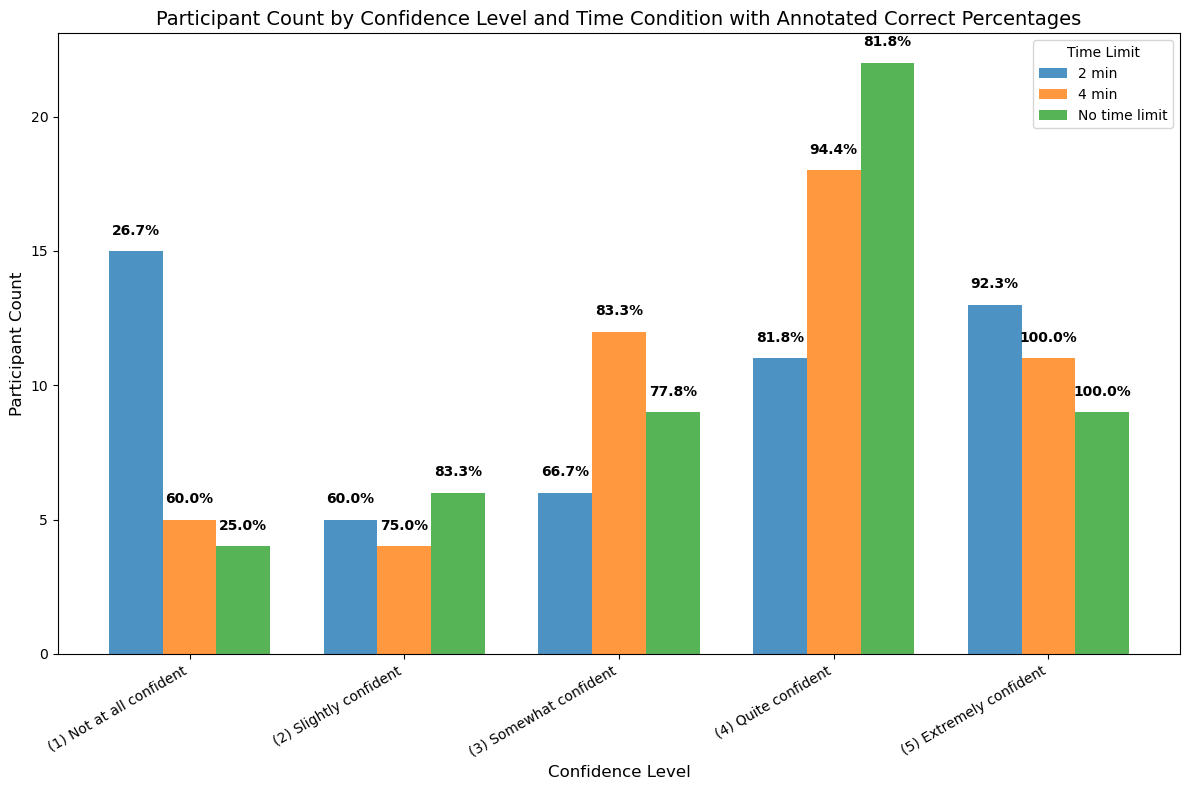
Bar chart illustrates the distribution of participant counts across five confidence levels for the three time conditions (2 minutes, 4 minutes and no time limit), with annotated percentages representing average correct counts based of participant count achieved within each group.
Experiement in Cognitive Science.
The Impact of Time Pressure on Problem-Solving Accuracy and Confidence
The study investigated the impact of varying time pressure on students problem-solving accuracy when using reference materials. Participants were assigned to one of three conditions: no time pressure, 2-minute time pressure, and 4-minute time pressure. Participants completed five problem-solving tasks and rated their confidence after each answer. Statistical analysis using Kruskal-Wallis and Mann-Whitney U tests revealed a significant difference in performance between the 2-minute and 4-minute conditions, while no significant differences were found between the other pairs.
Results indicated that participants under the 4-minute time pressure condition showed higher accuracy and confidence compared to those in the 2-minute condition, whose performance was significantly lower. These findings suggest that moderate time pressure optimizes problem-solving performance and confidence, providing valuable insights for task design in educational and professional contexts where time constraints are common.